


I wrote about Ruthie’s vision problems last week. Here is the second and last part of the story of a very sweet and good red heeler.
Vision Quest, Part 2
The Animal Eye Center is located in Rocklin, California, in the suburban corridor east of Sacramento where balayage meets Blue Lives Matter. It is in a one-story building with a stucco spray on coating and fake mini turrets at its corners. The long windows are fully covered with closed Venetian blinds for that maximum no-future feeling.
I parked and dragged Ruthie inside. We were promptly admitted to an exam room. The vet was young and less sporty and maybe more depressed than my regular vet, which I found reassuring. Ruthie might also have been reassured because she managed not to shit all over herself and everyone in a panic over being anywhere but inside our house.
Ruthie had glaucoma. The pressure from the fluid in her eyes was at 70, normal is well under 20. She was probably in terrible pain. There was no cure for canine glaucoma, the doctor said. To save the eyesight she had left we would have to start her immediately on three different kinds of eye drops. She’d get these three times a day. But the drops didn’t work forever. Why? No one knew. That was the first step.
The next might be to implant a valve, which would run us around $3500 per eye. These valves often failed so we might have to replace it. Was this a buy one, get one free situation? It was not.
The other option was to remove her eyes. I thought I was going to pass out.
Here I should mention that the regular non-specialist vet in Grass Valley had told me that Ruthie couldn’t possibly have glaucoma because she was healthy. Or maybe she said she was very unlikely to have glaucoma because she was healthy. Either way, her mistake was the equivalent of a people doctor telling a person they couldn’t possibly be pregnant because they only had sex once.
You’re probably thinking “Hey, you live in a small town, I sure hope you had a chance to randomly run into your vet so you could make her feel bad about telling you that it didn’t really matter when you took Ruthie to the Animal Eye Center even though it was hugely important to go NOW?” Thanks for asking, I did. It was such a relief to pass my own bad feelings onto someone else. This relief was not long-lasting, but I think we can all agree it was well-deserved.
The eye vet, who had clearly spent her time in vet school studying rather than filling up a tanning salon punch card like my regular vet, gave Ruthie a dose of eye drops. This involved some serious wrestling and yelping. She was very skilled yet it still looked hard and I believe the vet tech may have stepped in but I don’t want to swear to this and I do not want to be sued by the Animal Eye Center. “Do dogs get used to this,” I asked as she hurried away toward another vision-impaired pet. Her answer: “Some of them do. Some of them don’t.”
On the way home I called Ruthie’s dad and Ruthie’s Medical Advocate and told them Ruthie had glaucoma and we were going to have to give her $80 a month’s worth of drops for the rest of her life. I told them that she hated getting these drops so much I wasn’t sure it was going to be possible to administer them. I said that we might have to take out a second mortgage so that Ruthie and I could go live in storage space next to the Animal Eye Center. I said that Ruthie had been in pain and that hopefully the drops would help and hopefully she would stabilize and then we could discuss things like valves and Ruthie having no eyes.
No one wanted to believe that it was a real thing that a dog would ever have its eyes removed. I drove past T.J. Maxx, Bass Pro Shop and other venerable Rocklin institutions wondering how to bear it. My sweet Ruthie was already so afraid. How afraid would she be if she couldn’t see?
At home, I read tutorials and watched videos about how to give a dog eye drops. I tried not to focus on posts like “My dog will not let me give him eye drops I am at the end of my rope.” The tutorial providers acted like it was just a simple step-by-step process, like threading a needle or making a cake.
Soon evening/Dog Antietam was upon us. How we struggled against each other. A few times her mouth happened to be open while in the vicinity of my hand and then also strangely happened to close around it in such a way that her teeth made contact with my skin. Some people might say “Ruthie bit you.” Those people are bad. I screamed at Ruthie, “I’m trying to help you!”
I was despondent. Our friend Y. came over. His father has a fleet of Boston Terriers. Dogs are in his blood. I sobbed in his arms for a good three minutes. He promised me that things would get better, this was just the first day. I did not believe him.
Y. was good at giving Ruthie eye drops. When he held her and squeezed them in she looked so helpless and desperate to please. “You’re stronger than me,” I whined. He said that didn’t matter. “You just have to get her to submit to you, to let the dog know you’re in charge,” he said.
“But I’m not,” I said.
It was going to be hard for Y. to come around three times a day every day in the months and possibly years to come. I guess sometimes we could go to his house? We’d work it out!
The next morning Ruthie’s dad and I tried double-teaming her to give her drops and ended up lying on the floor clutching each other and sobbing. Ruthie, panting and enraged, drops of extremely expensive medicine all over her face but not in her eyes, glowered at us from underneath the dining room table. You had to space the drops out, three minutes in between each different kind. It wasn’t enough that our dog was going blind, we were now also expected to incorporate forty minutes of violence into our daily routine. Ruthie’s dad finally pulled it off out of sheer force and went to work. Ruthie forgot everything and put her head in my lap because I was crying. “I know,” I said. “Mommy is so, so, sorry.”
We thought our lives were over. Then we borrowed a muzzle from our neighbors, who are professional athletes. It was a real game changer. You slapped that thing on her and she became a good dog. When we got the muzzle on we would say in a booming voice, “Ruthie, it’s time to submit,” and she would suddenly go limp. After a few days we shortened it to “Submit.” Soon we didn’t need the muzzle.
The way you figure out your dog’s visual capacity is with a dog eye patch from Amazon and an obstacle course through large pieces of Styrofoam. That’s it. That’s the technology.
Ruthie’s dad and Ruthie’s Medical Advocate discovered Ruthie’s left eye was no longer working but that her right eye still had some juice. A few weeks ago she had an operation to remove the left eye and to put a valve into her right. It’s not what I wanted for Ruthie, who is still young, but she gets around fine and is more beautiful than ever.
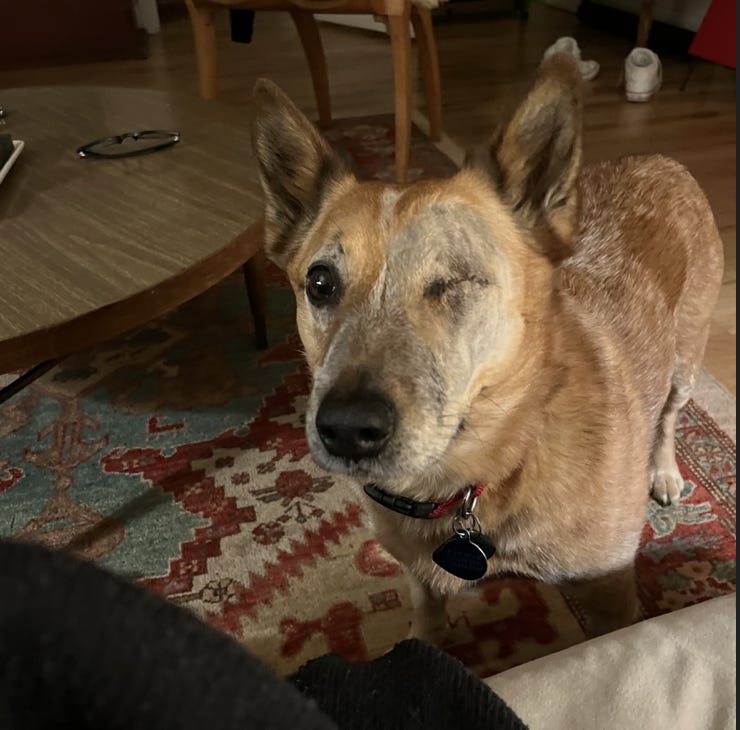
We still have to give her drops. The valve will probably have to be replaced, and when it stops working, we might have to remove her other eye, because the pressure will come back. I try not to think about that. I hope it’s a long time from now.
Ruthie’s dad said we never sat on the floor crying and clinging to each other on the bleak first morning after Ruthie’s diagnosis. But I swear it happened. You can ask Ruthie. Even if it was all cloudy, or just shapes moving against a background of other shapes, she remembers how sad we were for her, and for each other. She saw the whole thing.
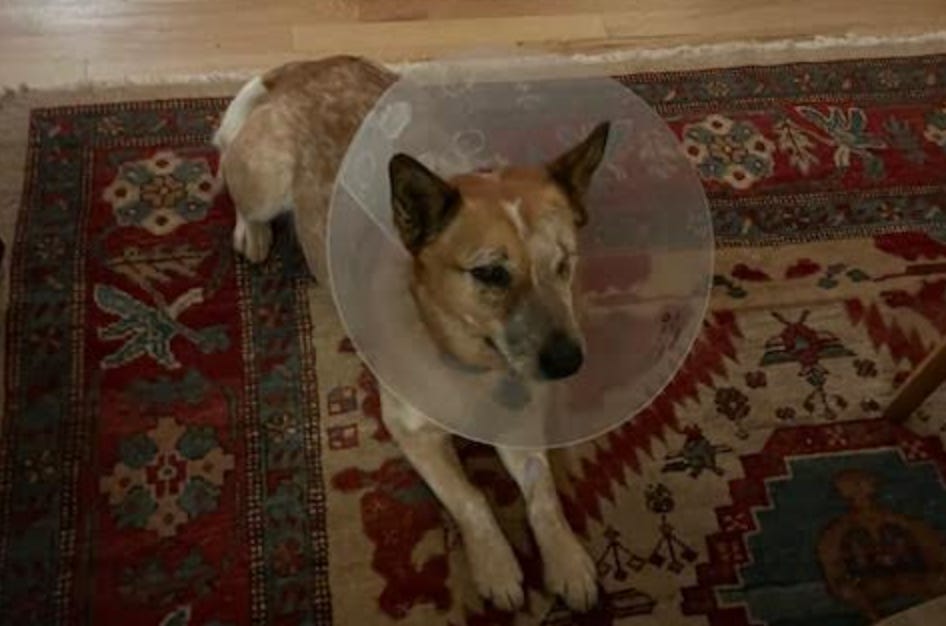
As a veterinarian and a reader, I want to let you know that, as long as you don't have a penchant for continuously rearranging your furniture, Ruthie can totally adapt and continue to have an excellent quality of life. Hang in there. She's so lucky to have you.
This was probably the funniest sad recounting of Ruthie and your travails, if that makes sense. I hope Ruthie feels better and that her parents do as well.